
July 31, 2026
18:00
“If you are not unhappy or discontented about anything, then your mind will
not be disturbed. Since your mind is not disturbed, the subtle wind energy
(Tib. lung) will not be disturbed. That means the other elements of the body
will not be disturbed either. As a result, your mind will not be disturbed, and
so it goes on, as the wheel of constant happiness turns.”
“Horses and donkeys with sores on their backs
Are an easy prey for scavenging birds.
People who are prone to fear,
Are easy victims to negative spirits.
But not those whose character is stable and strong.”
Sayings of the The siddhas of the past according to Jigme Tenpa’i Nyima
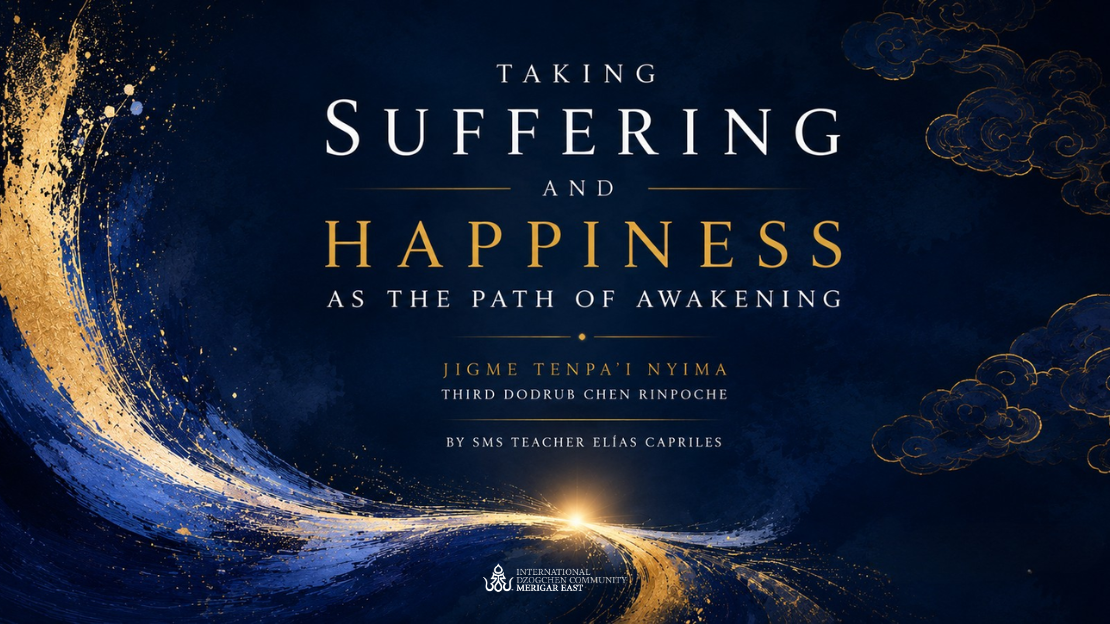
In this online course Elías Capriles will follow the short Mahayana text Taking Suffering and Happinness as the Path of Awakening by Jigme Tenpa’i Nyima, Third Dodrub Chen Rinpoche, which explains how both suffering and happiness can be used as precious aids on the Path of Awakening. Suffering is far easier to take into the Path, because most of us, on most occasions, rather than adhering to the experiences that induce suffering, reject them and want to get rid of them, since they are unwanted and unpleasant, and thus the disturbance may be used as a reminder to apply the instructions that will allow us to take the experience into the Path. Happiness is far more difficult to take into the Path, because we tend to adhere to the experience to derive pleasure, which makes it difficult to take a step back from the experience to apply the relevant instructions. However, both offer precious opportunities to dharma practitioners, because they make our delusion evident rather than being taken for granted and thus, we just let them be without even noticing them.
The Third Dodrubchen, Jigme Tenpai Nyima was born in 1865 as the eldest of eight sons of Dudjom Lingpa (1835-1904), from his mother, Sonam Tso. When Jigme Tenpai Nyima was eight years old, Patrul Rinpoche invited him to Dza Gyelgon and, at his request, the boy gave a teaching on the Bodhisattvacaryāvatāra before a large audience. Dza Patrul was so moved by the teaching that he declared to Jamyang Khyentse Wangpo (1820-1892) that here was proof that the Buddhist teachings were not in decline. He was a holder of Jigme Lingpa’s lineage, Among his disciples figure: Terton Sogyal Lerab Lingpa, Dorje Drak Rigdzin Chenpo , the Third Katok Situ, Chokyi Gyatso (1880-c.1923) Jamyang Khyentse Chokyi Lodro (1893-1959), Tsultrim Zangpo, and Dartang Choktrul Jigme Chokyi Dawa (1894-1958).
The second topic explores the profound Tibetan Buddhist understanding of dying as a sacred process—the fear of death and the fear of life as two pincers of the samsara vise, and how opening oneself to life to live life, and opening oneself to death to live death, are conditions for a good life and a good death.
Themes include: the taboo on death and the four reflections; losing the fear of death and the undesirable consequences of evading that awareness; the stages of dissolution of the elements (earth, water, fire, air) and the inner dissolution — Appearance, Increase, Full Attainment — through to the dawning of the Ground Luminosity, which is sometimes called “the mind of clear light of death”; practices to prepare for death, including the three types of phowa (Dharmakāya, Sambhogakāya, Nirmāṇakāya); liberation through the six bardos; and how to help others in the final moments of their lives.
Practical guidance covers how to be with the dying with sincerity and openness; liberation through tasting, dressing, listening, and speaking; body orientation and traditional Tibetan instructions for the dying and the deceased.
What then is happening when we die?
As the text says: “It is as if we are returning to our original state, everything dissolves, as body and mind are unravelled. The three ‘poisons’ — ignorance, desire, anger — all die… and then there is a gap. And where does this process take us? To the primordial ground of the nature of mind, in all its purity and natural simplicity.”
Read the full description here>>
31 July
18:00–20:00 — First session
1 August
11:00–13:00 — Morning session
16:00–18:00 — Afternoon session
2 August
11:00–13:00 — Morning session
16:00–18:00 — Afternoon session
Elías Capriles is an SMS (Śānta Mahā Saṅgha) teacher with decades of experience in the study and practice of Dzogchen, Tibetan Buddhism, and comparative philosophy. He has studied under eminent masters and is recognized for his ability to transmit classical Buddhist teachings in a way that is both doctrinally precise and accessible to Western practitioners.
The suggested donation for organising this retreat is 100 eur.
Your donations are vital for Merigar East’s survival. If you cannot donate this amount, please consider supporting any Gar and Ling with Karma yoga. Also, contact us, explaining your circumstances. No-one will be turned away for lack of funds.
The retreat will be held in English.
